




Debunking Affiliate Platform Migration Myths That Hold Operators Back
Affiliate platform migration is still surrounded by persistent myths: that it inevitably drags on for months, that historical data will disappear into a black hole, that affiliates will see gaps and panic the moment a switch is flipped, and so on. In this article, we take those myths head-on, examining where they came from, how modern systems actually behave during migration, and what operators need to control to avoid the failures that defined the past.
The Fear Is Outdated
Changing an affiliate platform is often seen as open-heart surgery because its commercial logic is fragile. A misrouted postback, a cookie domain mismatch, an override tier copied incorrectly – and you are looking at hours of answering angry emails and doing forensic accounting to reconstruct who is owed what.
That institutional memory is still very vivid in 2026. Many operators treat affiliate migration as a high-risk engineering event, delaying it until “after peak season” or bundling it into a larger replatforming initiative. The fear is rational. For years, affiliate stacks were tightly coupled to bespoke CRM integrations and undocumented deal logic living in someone’s inbox.
But the nature of the risk has shifted. Modern affiliate systems are API-driven and audit-logged by design. Infrastructure has matured; attribution pipelines are no longer the brittle scripts of the early 2010s. The real exposure today sits elsewhere. The real question is whether the organization can, field by field and event by event, explain how its revenue is calculated and prove it under scrutiny.
Myth #1 — “Migration Takes Months”
Concept: Everyone remembers drawn-out projects when every brand and campaign had to be hard-coded. That legacy view made it feel like switching affiliate software was inevitably a multi-month nightmare.
Mechanism: In the past, every operator had highly customized integrations: no standard APIs, no staging environments, and commissions were managed in spreadsheets. Migrating meant copying thousands of rules and retesting each one by hand.
But today’s platforms are API-first and repeatable. Many providers let you pull out your affiliate lists, campaign structures, and deal terms in bulk. In some cases, that leads to a launch in mere days. However, the timeline for a given operator depends on real factors: the number of brands, the complexity of deals (tiered CPA, sub-affiliates, hybrid models), and the degree to which tracking is integrated into your CRM or back office.
Migration Timeline Split
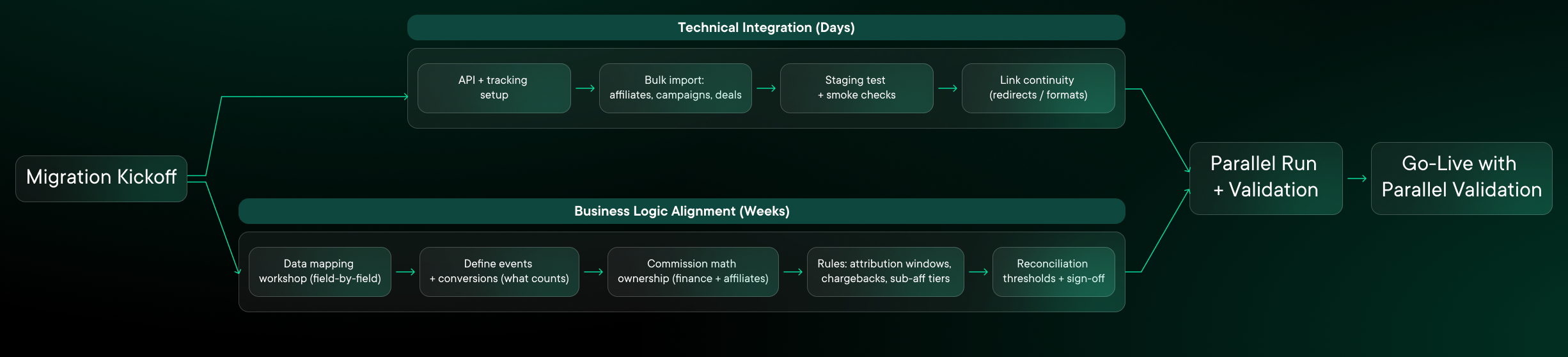
The biggest bottleneck is usually decision velocity. Running a data mapping workshop may take weeks in itself because you have to agree on who owns each commission rule and what constitutes a valid conversion. If your affiliate and finance teams fight over even small discrepancies (like how to handle returns on bonus-triggered deposits), the calendar stretches.
Impact: In practice, platform integration can be quick, but aligning on business logic takes time and often depends on internal alignment. In fact, most migrations take not months, but weeks. The span is wide because it reflects not just engineering but also regulatory requirements and, last but not least, the human factor.
Myth #2 — “We’ll Lose Affiliate Data and History”
Concept: Operators worry that a new platform means a black hole in their historical data: no past clicks, no deposit logs, lost audit trails.
Mechanism: In reality, losing history usually means you didn’t map it correctly. Historical data comes in pieces: affiliate profiles and KYC info, contract terms, clicks/impressions, player events (registrations, FTDs, NGR), and the payout ledger (completed payments and chargebacks). Each platform has its own schema, so a naive export might misalign fields. Affiliates fear losing IDs or having their links reset. Finance fears any gap in the audit trail – a missing date or mismatched player ID is a juicy dispute trigger.
The Data Continuity Map
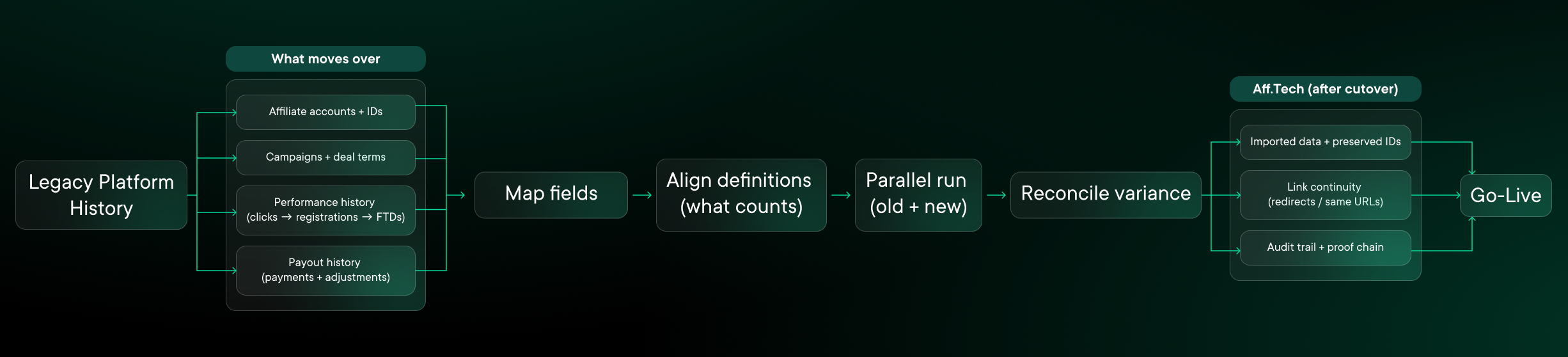
Operators should break apart the idea of history. Key constants, such as affiliate accounts and contract terms, are generally transferable: Aff.Tech offers to import your affiliate database and campaign data and automatically redirect old tracking URLs, so affiliates don’t have to swap links. We also support full data migration into the system, provided your current data is organized in a standard format (like a spreadsheet or database export).
Where operators lose grip is on definitions: Was a “conversion” defined exactly the same way on Day 1? Did old trackers have inconsistent SubID usage across brands? Often, the only loss is contextual. If your legacy tagging was unclear to begin with (e.g., some URLs lacked campaign IDs or were misrouted), the new system won’t automatically restore that clarity. In practice, teams conduct a reconciliation exercise: select a baseline period (e.g., the last 30 days) and run both systems in shadow mode. You compare output line by line. Any deviation beyond your tolerance gets investigated. This sampling uncovers “drift” (missing postbacks, truncated cookie windows, etc.), and you refine until both systems tell the same story.
Impact: In short, your history isn’t vanishing; you just have to rebuild the logic of each event from it and double-check that the math behind your old stats still makes sense in the new system. Your main job is to ensure you have a complete paper trail so that, when an affiliate asks, ‘Why is my balance this amount?’ you can prove it.
Myth #3 — “There Will Be Downtime (and Affiliates Will Panic)”
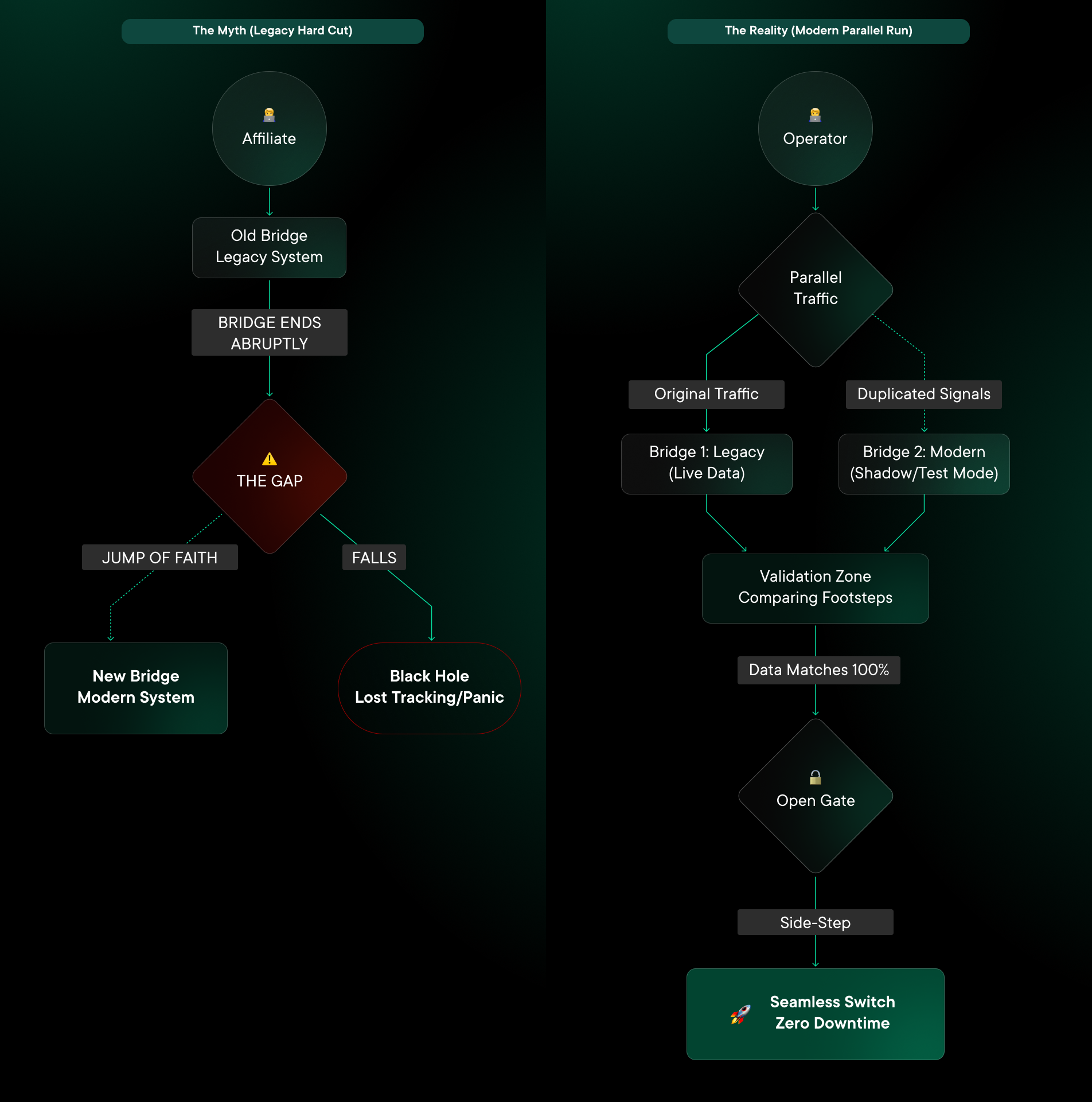
Concept: People use “downtime” to refer to an attribution blackout. The worry is that switching platforms will leave affiliates hanging – no clicks credited, no postbacks, blank dashboards. The old fear is a sudden traffic drop without explanation.
Mechanism: In fact, site uptime is typically unaffected. Modern affiliate migrations use a dual-postback or parallel tracking strategy to avoid any gap. In practice, you configure your flow to have conversions ping both the old and new systems simultaneously during cutover. Both platforms run together long enough to catch a drift before fully switching over. That means if a casino signs up or a deposit fires, both old and new tools see it and compare notes in real time. Matched pairs let you spot missing leads immediately, and you keep feeding the historical chain.
The Parallel Stream Comparison
Communication is the other half. Instead of silence, operators should treat affiliates as partners in the process. A proactive comms plan means announcing a migration well in advance and providing technical instructions (e.g., new tracking link formats), without overpromising zero change. You remind affiliates that conversion counts may fluctuate briefly as systems sync and provide a dedicated support contact for questions. If an edge case, such as a deposit return, triggers a tracking oddity, your process already has a dispute workflow: “Yes, this $100 FTD came from you, here’s the proof chain.”
Impact: When done right, affiliates actually welcome the continuity. In other words, affiliates don’t fear change; they fear unexplained numbers. Keeping old and new in sync ensures consistent results across both.
Myth #4 — “Integration and Maintenance Are on Us”
Concept: Vendors sometimes lead operators to believe the platform is hands-off. In reality, some tasks always stay with the operator.
Mechanism: A modern affiliate platform should definitely own the heavy lifting of infrastructure and ongoing technical support. For example, Aff.Tech handles monitored infrastructure, uptime SLOs, and security posture, so operators don’t sweat hosting or DDoS defenses. A proper platform also brings repeatable integrations (documented APIs and testing tools) plus migration assistance. We believe a robust affiliate solution must provide end-to-end support to ensure your integration is seamless and future-proof. In practice, that means our team helps set up postbacks, exchange test data, and stand by for bugs.
However, the operator still owns the math and governance. You must vet every commission model: no one knows your business rules as you do. The operator must align marketing, finance, and compliance on who approves deals, how to handle returns and chargebacks, and what constitutes fraud. For instance, before cutover finance needs to reconcile unpaid balances and ensure no commission threshold conflicts. You (the operator) are responsible for reporting definitions – e.g., confirming whether “NGR” means gross minus tax or something else – and ensuring the platform’s outputs match your general ledger. If a compliance regulator later audits affiliate activity, they’ll expect the operator to explain how tracking aligns with consent and anti-fraud policies; that’s on you, even if the platform stores the logs.
The Responsibility Boundary Model: Who Owns What After Go-Live
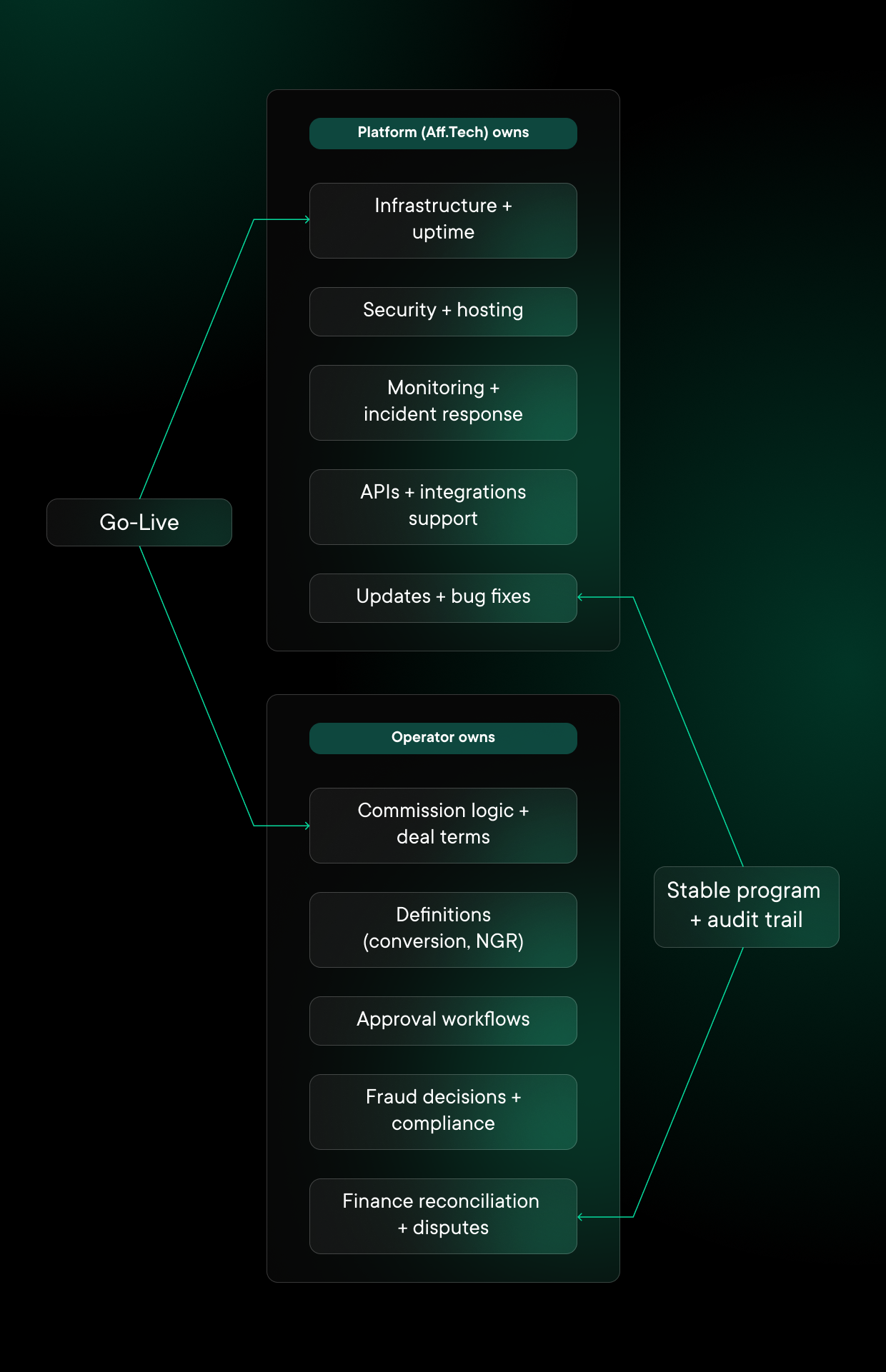
Impact: The upshot is that maintenance changes shape. Sooner or later, every migration drives an incident response discussion: Who gets paged if affiliates see a blip? Who runs the RCA? Usually, the platform team fixes the technical glitch, but the operator must decide if an unusual spike is actual fraud or a tracking bug. Likewise, ongoing duties such as KYC/AML checks and GDPR consents for affiliates remain with the operator’s compliance team.
What a Safe Migration Actually Looks Like
Think of migration as an operational hub. The key is to establish strong controls across teams. For instance, an affiliate project lead must drive the process end-to-end and all other stakeholders funnel their approvals through that owner, avoiding endless email loops. Every event (player deposit, registration, etc.) must have a clear source of truth: one master event log, whether it’s in your platform or CRM, so that you can always trace a number back to a defined input.
A live parallel validation phase is non-negotiable. During this shadow period, daily or weekly audits compare old vs new. You set thresholds for acceptable variance (typically below 1%), and any deviations trigger immediate corrective actions. We recommend running both systems in parallel and checking conversions daily during launch week – exactly how to catch a lost postback before it becomes an invoice dispute.
Communication runs alongside every technical step. You may set up a weekly affiliate briefing to keep partners informed about what’s happening and when to expect changes. We advise involving finance and legal early and keeping affiliates informed weekly to smooth the transition.
Finally, think beyond go-live. Post-migration monitoring becomes a permanent control. Use your analytics to compare each affiliate’s performance over rolling periods. A one-week monitoring sprint is not enough; build an ongoing report (e.g., Conversion Rate by Affiliate, Approval Ratios) to spot long-tail drift. In many ways, migration just formalized the auditing you should already be doing: make reconciliation and variance checks part of normal operations.
Conclusion: The Control Tower Moment
For years, affiliate migration has been treated as something to survive. A technical event to minimize, postpone, or bundle into a larger transformation so the pain feels justified. But the operators who move decisively in 2026 understand that most of what used to “break” during a switch was never the platform itself. It was undocumented deal logic. It was conflicting definitions of NGR. It was silent assumptions between marketing and finance that no one had written down.
A migration forces those assumptions into the open. It requires you to define what constitutes a valid conversion, who owns commission math, what variance is acceptable, and how disputes are resolved before they escalate. In that sense, the switch is a systems audit that exposes fragility you would rather discover in a controlled parallel run than in a regulator’s inquiry or an affiliate’s invoice dispute.
The operators who benefit most from a migration are the ones who use the moment to establish a single, defensible source of truth across teams. When done deliberately, the outcome is faster partner onboarding, cleaner reporting to finance, clearer fraud detection, and fewer Friday-night surprises.
If you approach migration as governance work, you regain control of a channel that often runs on historical habit rather than documented logic. And once that control is in place, switching platforms becomes a routine infrastructure decision, made with the same discipline you apply to payments or KYC. That shift in mindset is the real upgrade.

FAQ
FAQ
How long does it take to migrate to a new affiliate platform?
Migration can take anywhere from a few days to several weeks. The technical integration itself is often fast with modern API-driven platforms, but the overall timeline depends on business complexity, number of brands, deal structures, and internal alignment. In most cases, the longest phase is agreeing on commission logic and validating results through a parallel run before final cutover.
Can we migrate without losing affiliate lists and historical performance data?
Yes. With Aff.Tech, affiliate databases, campaign logic, historical clicks, player events, and payout ledgers can be fully migrated, provided your data is exportable in a standard format. We handle structured data imports and can automatically redirect existing tracking URLs so affiliates don’t need to change links. During cutover, parallel tracking ensures both systems run simultaneously, allowing line-by-line validation before switch-off. Data isn’t lost; it’s reconciled and rebuilt with full audit continuity.
Will the migration cause downtime or impact tracking?
No. A properly managed migration should not cause downtime or an attribution blackout. Aff.Tech uses parallel tracking during cutover, with both old and new systems receiving conversion data simultaneously. This allows line-by-line validation before the final switch. Existing tracking URLs can be automatically redirected, so affiliates don’t need to replace links. Any short-term variance is typically due to definition alignment, not lost data.
What should we prepare before starting the migration?
Start by organizing clean exports of your affiliate database, deal terms, campaign structures, and historical performance data. Align internally on how you define key metrics like NGR, valid conversions, and commission logic, and reconcile unpaid balances before cutover. Appoint a single migration owner and involve finance and compliance early. Document commission models, filters, and lead qualification rules so they can be rebuilt accurately. Finally, prepare a clear affiliate communication plan to manage expectations during parallel validation.
How do we communicate migration to affiliates without losing partners?
Communicate early and transparently. Announce the migration in advance, explain the timeline, and clarify that short-term fluctuations may occur during parallel validation. Reassure partners that tracking continuity is protected; Aff.Tech can automatically redirect existing URLs and run both systems simultaneously to validate results. Provide a dedicated support contact and clear dispute workflow, and remember: Affiliates don’t fear change; they fear unexplained numbers.
Can we migrate selectively (only certain partners/campaigns)?
Yes. Selective migration is often the safest way to switch platforms because it lets you move in controlled slices instead of betting everything on a single cutover. With Aff.Tech you can start with a defined scope (specific partners, campaigns, brands, or markets) while keeping the rest on the legacy system until you are ready. That approach works well when deal logic varies across segments, when different brands use different conversion definitions, or when you want to protect your highest-volume partners with extra validation. In practice, you migrate the chosen set’s affiliate profiles, contracts, links, and reporting history, then run parallel tracking so conversions are recorded in both systems during the transition. This gives you a real comparison set: you can reconcile clicks-to-registrations, FTDs, and payout calculations before expanding scope. Aff.Tech also supports granular configuration by geo, brand, and currency, so you can replicate the commercial rules that apply to just that segment and validate them without waiting for every contract in the program to be mapped. Once the variance stays within an agreed tolerance, you can onboard the next tranche. The result is a staged rollout that reduces risk, keeps partners stable, and allows internal teams to align business rules incrementally rather than forcing one giant “definition day” across the entire affiliate book.
Do we get support after go-live (maintenance and updates)?
Yes. Aff.Tech provides ongoing technical support after go-live, including monitored infrastructure, uptime SLOs, security management, and regular platform updates. Our team remains available to resolve technical issues and support performance monitoring. While we handle infrastructure and system health, operators retain control over commission governance, fraud oversight, and financial reconciliation to ensure long-term program stability.
When does it make sense to migrate vs stay on the current platform?
Consider migrating when your current platform slows execution or creates recurring reconciliation work: manual commission fixes, unclear NGR definitions, limited reporting, or difficulty launching new brands and deal structures. If attribution issues regularly require forensic analysis, the cost of staying may exceed the risk of moving.